


NASA launches its Roman Space Telescope to explore the hidden universe
NASA launches its Roman Space Telescope to explore the hidden universe

William HarwoodSun, August 30, 2026 at 12:22 PM UTC
4
NASA's $4.3 billion Roman Space Telescope was launched atop a SpaceX Falcon Heavy rocket Sunday, kicking off a three-month voyage to a point in space a million miles from Earth where it will map the large-scale structure of the cosmos with a wide-field 300-megapixel camera.
Using a Hubble-class mirror originally built for a spy satellite, Roman will search for clues about the nature of repulsive dark energy, which is accelerating the expansion of the universe, along with probing the distribution of equally mysterious dark matter, which holds galaxies together and accounts for most of its mass.
A second instrument, an experimental coronagraph with shape-shifting mirrors that can dim the glare of distant suns, will allow astronomers to analyze the light reflected from vastly dimmer Jupiter-size planets to tease out details about their chemical makeup.
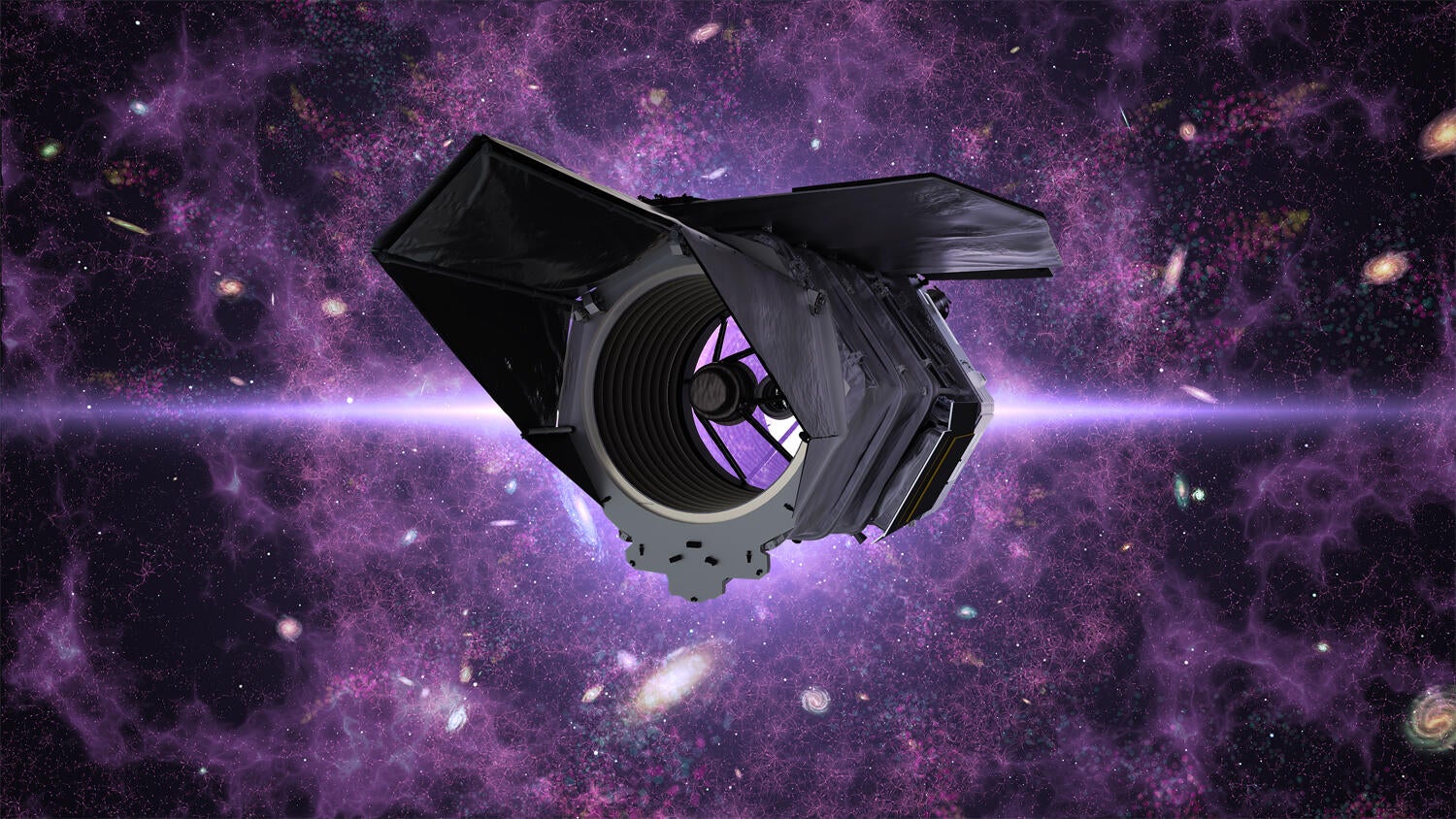
At the same time, Roman's wide-field camera will look for stars that periodically dim as planets pass in front as viewed from the telescope. Some 6,200 exoplanets have been discovered to date. By the end of Roman's mission, that number is expected to climb well above 100,000.
Along with a treasure trove of exoplanets, Roman is expected to catalog some 20 billion stars, 2 billion or more individual galaxies, tens of thousands of supernova blasts and countless transient events like flares generated by stars torn apart by close encounters with black holes.
"Roman is going to revolutionize the way we look at our universe," NASA science chief Nicky Fox said after launch. "It is going to measure dark matter, which is like the fabric of the universe; it's the thing you can't see, but we know it's there.
"It's going to measure dark energy, which kind of powers the universe. [There is] sort of a cosmic struggle between dark matter that wants to pull things together and dark energy that wants to push things apart. And [Roman] will allow us to finally kind of explain our universe and understand our place in it."
In addition, she said, the telescope will find "tens of thousands of exoplanets, planets that we don't even know are there, billions of galaxies, tens of billions of stars. It's just a spectacular mission."
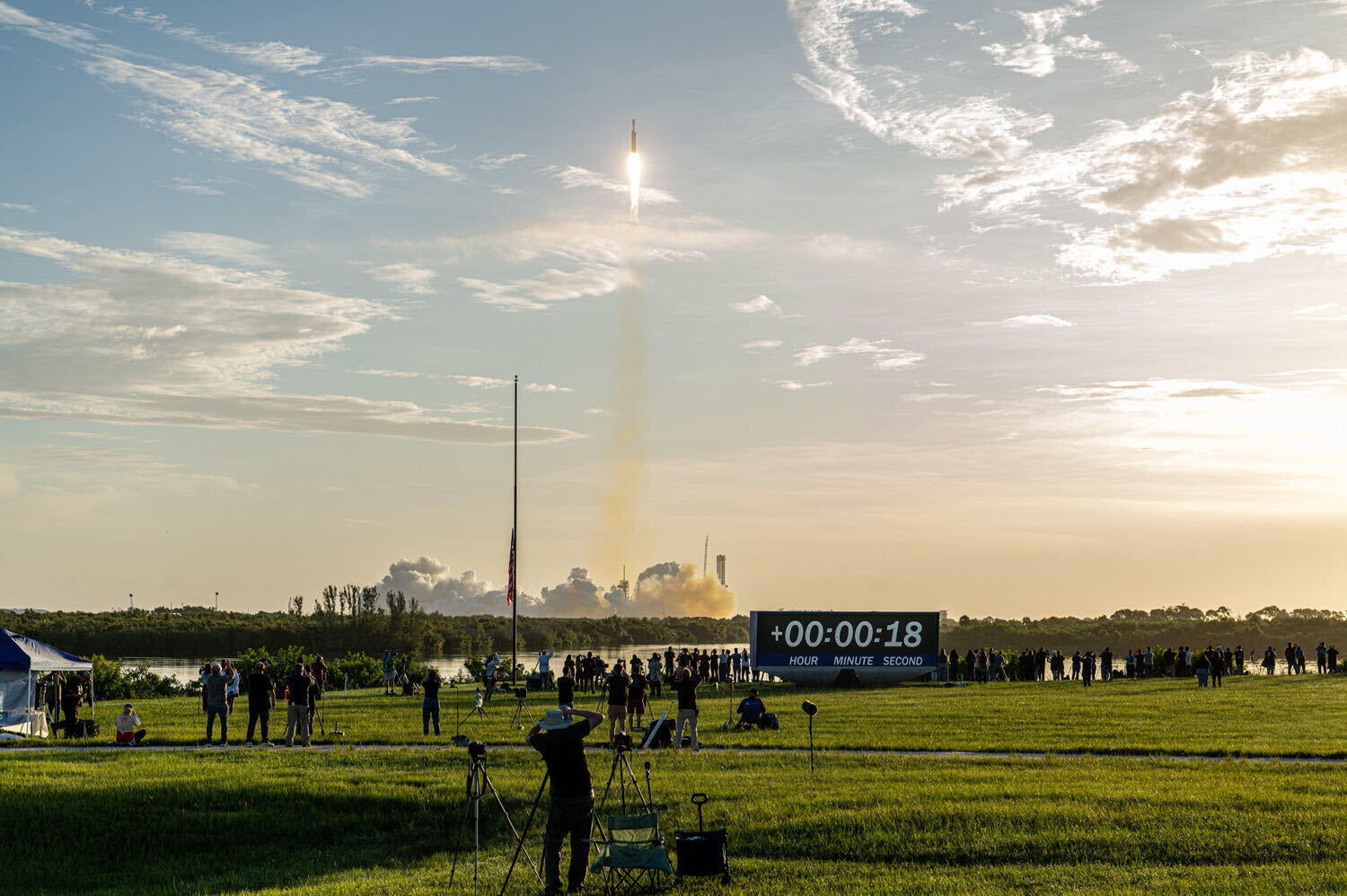
The long-awaited flight got underway at 7:26 a.m. EDT when the Falcon Heavy's three core stages, each powered by nine kerosene-burning Merlin engines, roared to life, throttled up to a combined 3.7 million pounds of thrust and majestically climbed away from historic Pad 39A at the Kennedy Space Center.
It was only the 13th flight of a Falcon Heavy, the most powerful operational rocket in the SpaceX inventory, and it provided a spectacular weekend sky show for area residents, tourists and space center workers as it rapidly raced away on an easterly trajectory over the Atlantic Ocean.
The rocket's two strap-on side boosters, one making its first flight and the other its third, shut down and peeled away 2 1/2 minutes after liftoff. Both boosters then flipped around, reversed course and flew back to on-target landings at the Cape Canaveral Space Force Station.
The central core stage, meanwhile, continued firing for another minute and a half, then it, too, shut down and fell into the Atlantic as planned after using all of its propellant to maximize performance.
The second stage then took over, firing twice to reach the required trajectory. The 18,000-pound Nancy Grace Roman Space Telescope, named after NASA's first chief astronomer who long championed the value of space-based telescopes, was released to fly on its own 31 minutes after liftoff.
Advertisement
It is bound for Lagrange Point No. 2, about a million miles on the opposite side of Earth from the sun, where the gravity of Earth, sun, and moon balance out, allowing spacecraft to remain in place with minimal use of fuel. The James Webb Space Telescope is stationed in the same region.
It will take about 100 days to reach L2. Once on station, Roman will study the effects of dark matter, the mysterious substance that pervades the universe, holds galaxies and galactic clusters together and accounts for most of the mass in the cosmos.
At the same time, Roman will work to gain statistically significant insights into the nature of the equally mysterious dark energy, a repulsive force presumably present since the Big Bang that became dominant about 5 billion years ago as the universe expanded and thinned out. Ever since, the expansion of the cosmos has been speeding up.
While no one yet knows what dark energy actually is, Roman may help resolve a conflict between the strength of the force in the very early universe, as measured by probes studying the remnant 3-degree glow of the Big Bang's immediate aftermath, compared to Hubble observations of a specific type of supernova that indicate a slightly different value.
The discrepancy, known as "the Hubble tension," indicates a potentially serious flaw in the standard model of cosmology, the current understanding of how the universe, and everything in it, has evolved. It might even indicate dark energy is not the constant force it is thought to be, but might somehow change over time.
"We're probably not going to confirm the standard model of how the universe works," Julie McEnery, Roman Space Telescope senior project scientist, said. "We're very likely to demonstrate that our standard model is wrong, and to set ourselves on a path to figuring out how does our universe really work. It's hard to get [a better question than] the fundamental nature of your universe!"
Roman's wide-field camera is one of two instruments aboard the spacecraft. The other is an advanced coronagraph equipped with deformable mirrors that can block out the glare of a star to detect the vastly dimmer light reflected from the atmosphere of an orbiting planet.
Roman's coronagraph is expected to detect Jupiter-size planets orbiting Earth-like stars. By analyzing that reflected light, researchers may be able to determine the elemental composition of those atmospheres.
"We think that we will be capable of detecting exoplanets that are about 100 million times fainter than their stars, and with that capability, we are hoping to see ... a Jupiter twin around a nearby star using visible light reflected from its cloud tops for the first time," said Vanessa Bailey, the Roman coronagraph instrument scientist at the Jet Propulsion Laboratory. "Then, we can use that light to study the composition of its atmosphere."
The coronagraph, about the size of a baby grand piano, is one of the most complex instruments ever launched.
If the technology works, a more sophisticated version could make its way into a future space telescope capable of directly imaging Earth-like planets orbiting sun-like stars and collecting spectra that could be analyzed for the chemical signs of biological activity.
Lindsay Clancy trial jurors have a question for the judge as they deliberate
What Meta's massive $17 billion social media addiction settlement means for your family
Husband-wife duo team on a mission to race all World Marathon Majors, in hopes of inspiring others
Source: “AOL Breaking”
