


Avengers can't get an IMAX screen this December, so Disney invented its own premium format to fight back
Avengers can't get an IMAX screen this December, so Disney invented its own premium format to fight back

Dave SmithTue, July 21, 2026 at 11:35 AM UTC
0
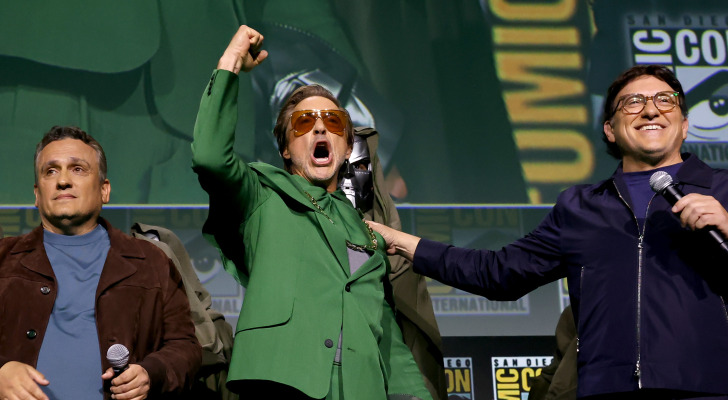
Disney (NYSE: DIS) released the first full trailer for Avengers: Doomsday on Monday, giving fans their clearest look yet at Robert Downey Jr.'s Doctor Doom ahead of the film's December 18 release. But tucked away at the very end of the Marvel Studios trailer was an advertisement to see the film in "Infinity Vision," which Disney describes as a new certification for Premium Large Format theaters guaranteeing moviegoers big screens, bright images and outstanding sound. Disney is rolling it out first with the September re-release of Avengers: Endgame before Doomsday arrives in December.
But if you're wondering what Infinity Vision actually is, you're not alone. It sounds like a piece of technology, but it isn't — at least not in the way IMAX is. It's a label, but the reason behind it comes down to, you guessed it, money, as well as the competition around a single Friday in December.
Top Picks -
Dave Ramsey warns nearly 50% of Americans are making 1 big Social Security mistake — here’s what it is and 3 simple steps to fix it ASAP
The tax breaks in Trump's 'big beautiful bill' expire after 2028 — and experts say most people won't act in time. What to do before the window closes
Jeff Bezos backs a platform that lets anyone invest in rental homes for as little as $100 — 6 ways to build wealth like a landlord without actually being one
What is Infinity Vision?
Disney announced Infinity Vision in April on stage at CinemaCon, the annual Las Vegas convention where studios pitch theater owners on the year ahead. Disney called Infinity Vision a new certification for premium large format theaters, built in collaboration with global exhibition partners, that signals to audiences which auditoriums offer the biggest, brightest and most immersive experience.
But the thing about Infinity Vision is that it’s not hardware; Disney did not actually build a screen or invent a projector here. It’s basically a stamp of approval that gets applied to premium screens that already exist. Disney said there are already more than 75 domestic and 300 global premium large-format auditoriums that consumers can choose from, and the point of the certification is to help audiences identify the best of them.
Real quick: "Premium Large Format," or PLF, is the broad industry term for any auditorium that charges extra for a bigger screen, sharper picture and louder sound. IMAX is the most famous example, but there are plenty of others like Dolby Cinema, Cinemark's XD and Regal's RPX, which all compete in the same space. IMAX doesn't like to be lumped in with the others because it uses its own proprietary technology and largely decides which movies play on its roughly 400 North American screens.
To carry Disney’s Infinity Vision badge, a screen has to clear a technical bar. According to Bloomberg, an auditorium needs a screen at least 50 feet wide, a laser projection system and 7.1-channel Dolby surround sound to qualify. Disney's own description emphasizes the largest screens for scale, laser projection for brightness and premium audio for immersive sound. In late June, Disney said the program had received more than 7,500 applications from screens around the world seeking approval, so the demand seems to be there.
What Disney is doing here might be effective, but it’s not exactly novel. Lucasfilm did the same thing when it created the THX certification for the 1983 launch of Return of the Jedi, a stamp meant to guarantee that theaters met a minimum standard for picture and sound.
Read More: Millionaires under 43 hold only 25% of their wealth in stocks. Here’s where their money is actually going
Advertisement
Why Disney had to build its own premium brand
The birth of Infinity Vision has a lot to do with IMAX. Both Avengers: Doomsday and Warner Bros. and Legendary's Dune: Part Three are opening on the exact same day, December 18.
While some on the internet are trying to make “Dunesday” happen — essentially getting folks to see both movies back-to-back, in the same way “Barbenheimer” (watching Barbie and Oppenheimer as a double-feature) was a thing in 2023, though that phenomenon was much more organic — there’s a little more than just friendly rivalry at play here.
Dune: Part Three managed to lock in North America's ~400 IMAX screens for three weeks, meaning the premium large-format dollars that usually flow toward a Marvel blockbuster will be tied up in Dune territory for the entirety of the Avengers opening weekend and beyond. Denis Villeneuve shot much of the film with IMAX cameras and has a close relationship with the format, which is a big reason the theater chain sided with the filmmaker over Marvel’s superhero franchise.
Thing is, losing out on IMAX is as big as the screens are. Premium screens punch well above their weight at the box office. As of 2024, PLF screens made up a fraction of North American theaters but accounted for 9.1% of the domestic box office — around $600 million. IMAX alone, despite occupying less than 5% of global screens, regularly captures up to a quarter of a major film's opening-weekend gross. And IMAX is big (literally) and getting bigger (figuratively): IMAX generated a record $1.28 billion at the global box office in 2025, a more than 40% jump over the prior year.
History shows exactly what Marvel stands to leave on the table. In 2019, Avengers: Endgame earned $91.5 million in its domestic opening weekend, with IMAX contributing tens of millions on top of that across its first two weekends.
Disney had options. It could have moved Doomsday up to grab IMAX screens on the front end, but the Infinity Vision rollout makes clear that isn't happening. Instead, the studio is doubling down on that release date and its own certification, slapping it on hundreds of premium non-IMAX screens, in hopes that can capture some of that sweet premium-ticket revenue and marketing.
But, to be clear, you can be a blockbuster and survive — even thrive — without IMAX. In the case of “Barbenheimer,” Greta Gerwig’s Barbie got shut out by Christopher Nolan's Oppenheimer for those IMAX screens, yet it still grossed north of $1.4 billion worldwide.
This could be a crucial moment for Disney, which is now under a new CEO (Josh D'Amaro), and comes right after Disney cut roughly 1,000 jobs, including members of Marvel's art team, earlier this year. But Disney knows its premier franchise has the goods to make it all work: Avengers: Endgame made close to $2.8 billion in 2019, while Dune: Part Two made around $700 million, so Disney is banking on Infinity Vision to further fuel Doomsday as a much-needed comeback vehicle for the House of Mouse.
What To Read Next -
Here’s the average income of Americans by age in 2026. Are you keeping up or falling behind?
Robert Kiyosaki issued grim warning for baby boomers. Many could be ‘wiped out’ and homeless ‘all over’ the country. How to protect yourself now
Vanguard’s outlook on U.S. stocks is raising alarm bells for retirees. Here’s why and how to protect yourself
Are you paying too much for car insurance? Here are 3 clever ways to slash your monthly bill
This article provides information only and should not be construed as advice. It is provided without warranty of any kind.
Source: “AOL Entertainment”
